Slack · UX Research · 2026
Studying what happens when work, messages, and 67 unread notifications collide.
Role
UX Researcher
Team
Brayden, Bess, Finley, Yu Dian
Duration
10 Weeks
Year
2026
The Project
Making workplace communication easier to understand.
Slack is one of the most widely used workplace communication tools, but many of its most important features are hidden behind unclear terminology, fragmented navigation, and invisible system states. This project evaluated Slack through heuristic analysis, moderated usability testing, redesign, and validation testing to uncover where users struggle and how targeted design changes could improve task success.
My Role
I led research synthesis, usability testing, and participant analysis. I helped identify high-severity usability issues, translate findings into redesign concepts, and validate solutions through a second round of testing.
The Problem
Slack hides its own state.
When users need to find saved information, understand why they are receiving notifications, or navigate a new workspace, they often believe they completed tasks successfully when they actually failed. The problem was not that users could not click buttons. The problem was that Slack frequently failed to communicate where information lived, what actions did, and whether a task was completed.
The result was false confidence, confusion, and wasted time. Users were finishing tasks wrong and had no idea.
Process
Four stages from evaluation to validation.
We followed a full research-to-validation loop. Each stage directly informed the next — heuristic issues shaped our test tasks, test failures shaped our redesigns, and the redesigns were validated with a fresh cohort.
Heuristic Evaluation
12 workflows reviewed against Nielsen's 10 heuristics to surface issues before touching users
Moderated Testing
8 participants completed structured tasks with a facilitator watching in real time
Redesign
Targeted solutions built for the two highest-severity issues found in testing
Validation Testing
8 new participants tested the redesigned experiences unmoderated to confirm improvements
Heuristic Evaluation
12 workflows. Four recurring themes.
Before running any user tests, we evaluated 12 Slack workflows against Nielsen's 10 usability heuristics — covering notifications, saved messages, direct messages, channels, status and presence, huddles, and reminders. Four themes emerged consistently across almost every workflow.
Visibility Breaks Down
Critical system state was hidden or absent at the moments users needed it most
Weak or Missing Feedback
Actions completed without confirmation, leaving users uncertain whether anything happened
Fragmented Navigation
Related settings were split across multiple menus with no clear path between them
Workflow Friction
Simple tasks required more steps than expected, creating consistent drop-off patterns
Key Finding
Users did not know they were failing.
Across multiple tasks, participants often believed they had completed the objective successfully. In reality, they could not find saved messages, misunderstood notification settings, and misinterpreted system feedback. Slack rarely communicated failure clearly. Users were confidently wrong.
This is a more dangerous failure mode than simple confusion. When the interface gives users false confidence, they stop looking for the right answer.
User Testing
Three tasks. Two major failures. One root cause.
Eight participants completed three structured tasks in a moderated session with the original Slack. A second cohort of eight then tested the redesigned flows unmoderated. The contrast between the two rounds tells the story.
Unmoderated Results — after redesign
| ID | Task 1: Navigation | Task 2: Message Retrieval | Task 3: Notifications |
|---|---|---|---|
| P2 | Completed, 5 — very easy | Completed — went to Later tab | Completed, 4 |
| P3 | Complete | Completed very easy | Completed, a little confused |
| P4 | Complete, 4 | Completed, 4 | Completed, 4 |
| P5 | Complete, 5 — very easy | Complete, 5 — very easy | Complete |
| P6 | Complete, 5 | Complete, 5 | Completed |
| P7 | Completed, 4 | Complete, 5 | Completed |
| P8 | Completed, 5 | Completed, 5 | N/A |
| P9 | Completed, 5 — very easy | Completed, 5 | Complete, 4 |
Moderated Results — original Slack
| ID | Task 1: Navigation | Task 2: Message Retrieval | Task 3: Notifications |
|---|---|---|---|
| P1 | Sent a message | Identified Ethan's message | Failed to adjust notifications |
| P2 | Sent a message | Did not identify Ethan's message | Went to account notification settings |
| P3 | Sent a message | Did not identify Ethan's message | Failed to adjust notifications |
| P4 | Sent a message | Did not identify Ethan's message | Failed to adjust notifications |
| P5 | Sent a message | Identified Ethan's message | Failed to adjust notifications |
| P6 | Sent a message | Did not identify Ethan's message | Went to account notification settings |
| P7 | Sent a message | Did not identify Ethan's message | Failed to adjust notifications |
| P8 | Sent a message | Identified Ethan's message | Failed to adjust notifications |
Navigation and Orientation
"Find where your team is communicating and introduce yourself."
Moderated
8/8
Users immediately understood Slack's channel structure. The layout matched their existing mental models of workplace communication tools.
"Ohhh Slack. I feel comfy here."
Navigation worked because it met expectations. When Slack matches how users already think, it is invisible in the best way.
Message Retrieval
"Find the message your manager saved for you."
Moderated
3/8
Unmoderated
8/8
Severity
4/4
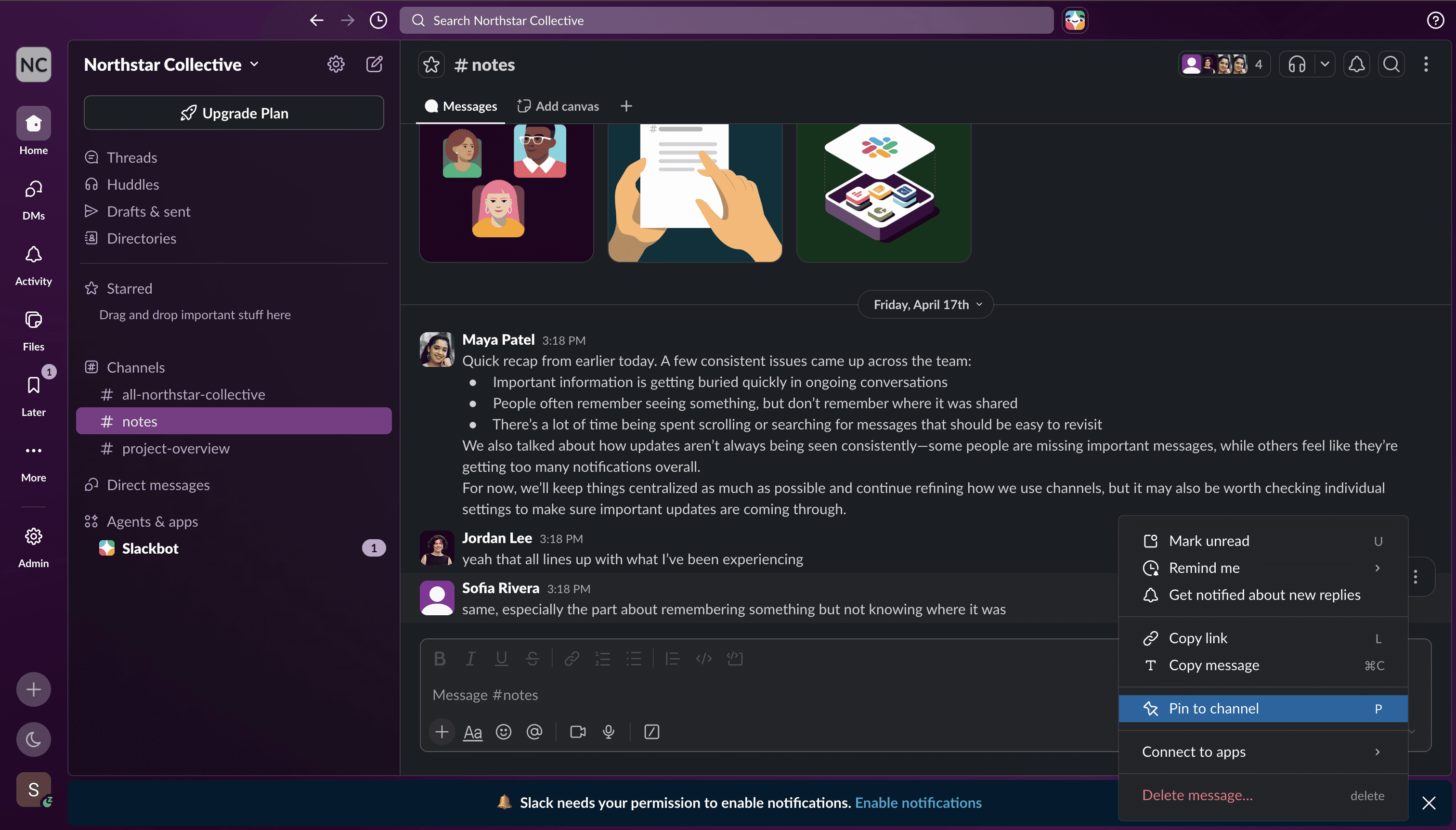
Users could not distinguish between Saved, Pinned, and Later. Most searched multiple locations before giving up or accepting an incorrect result.
"There is usually a saved button here. This is terribly confusing."
Users understood saving as a concept but Slack's implementation did not match. The terminology and location were both misaligned with user expectations.
Notification Prioritization
"Figure out why you are receiving notifications and update your settings."
Moderated
2/8
Unmoderated
8/8
Severity
4/4
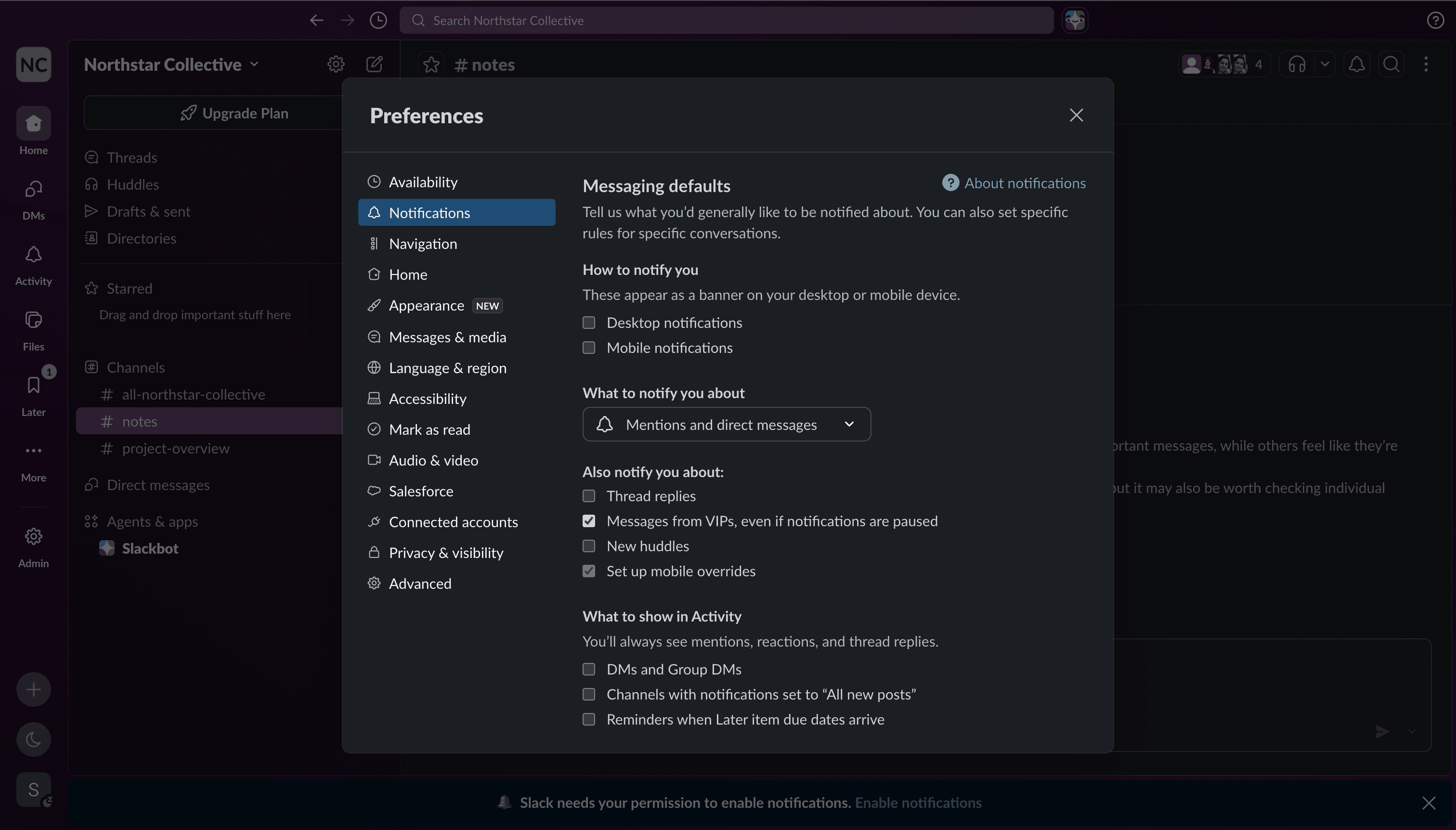
Notification settings were spread across at least three separate menus. Users could not determine what settings were active, why notifications appeared, or where the controls lived.
"I have no idea where to even start with this."
Critical system state was hidden. Users needed to know what was happening before they could change it, and Slack never told them.
Final Design
Two improvements. One goal.
Both redesigns targeted the same underlying problem: Slack was not communicating what it was doing. The solutions made system state visible and language clear.
Redesign 01
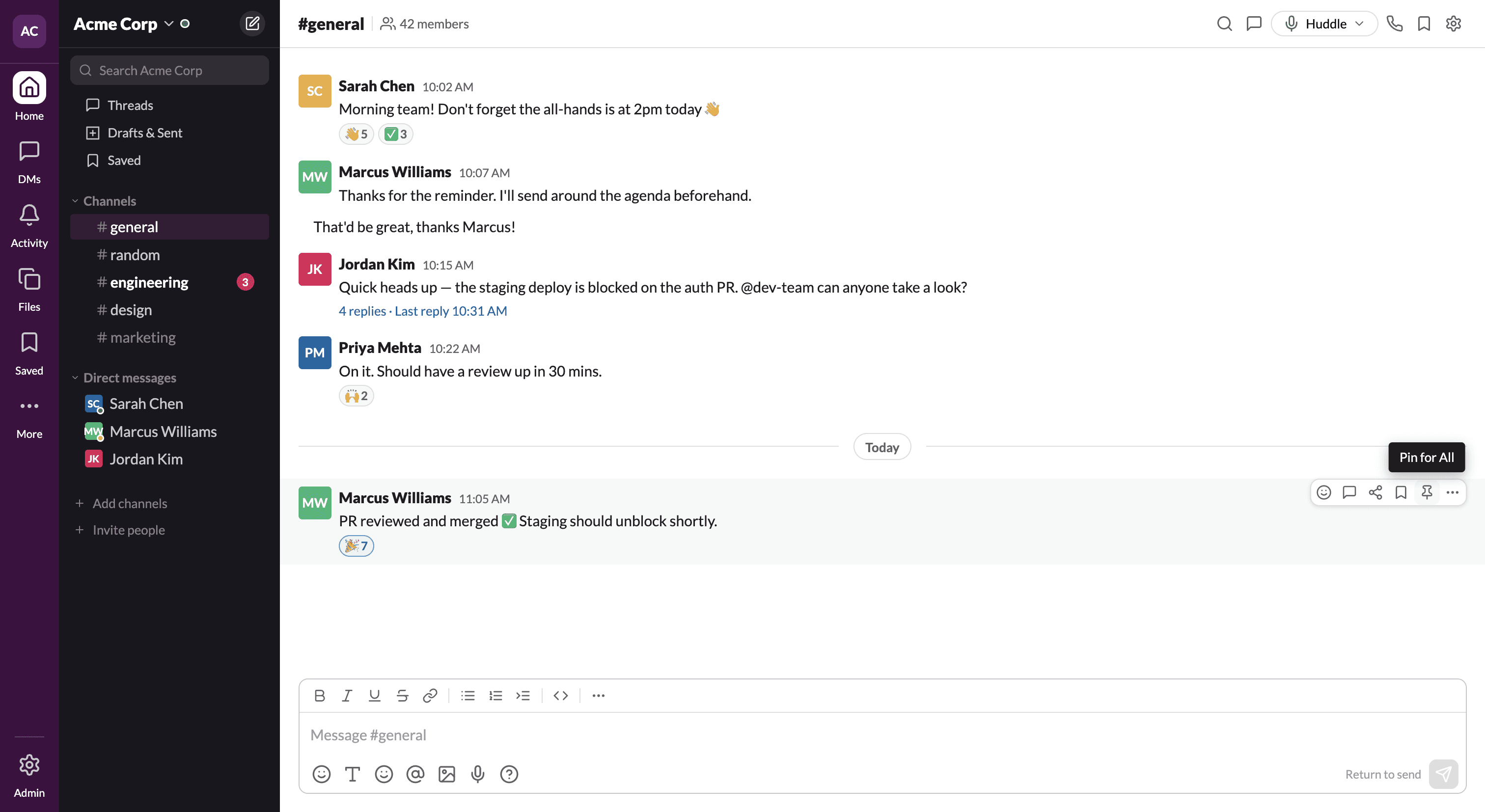
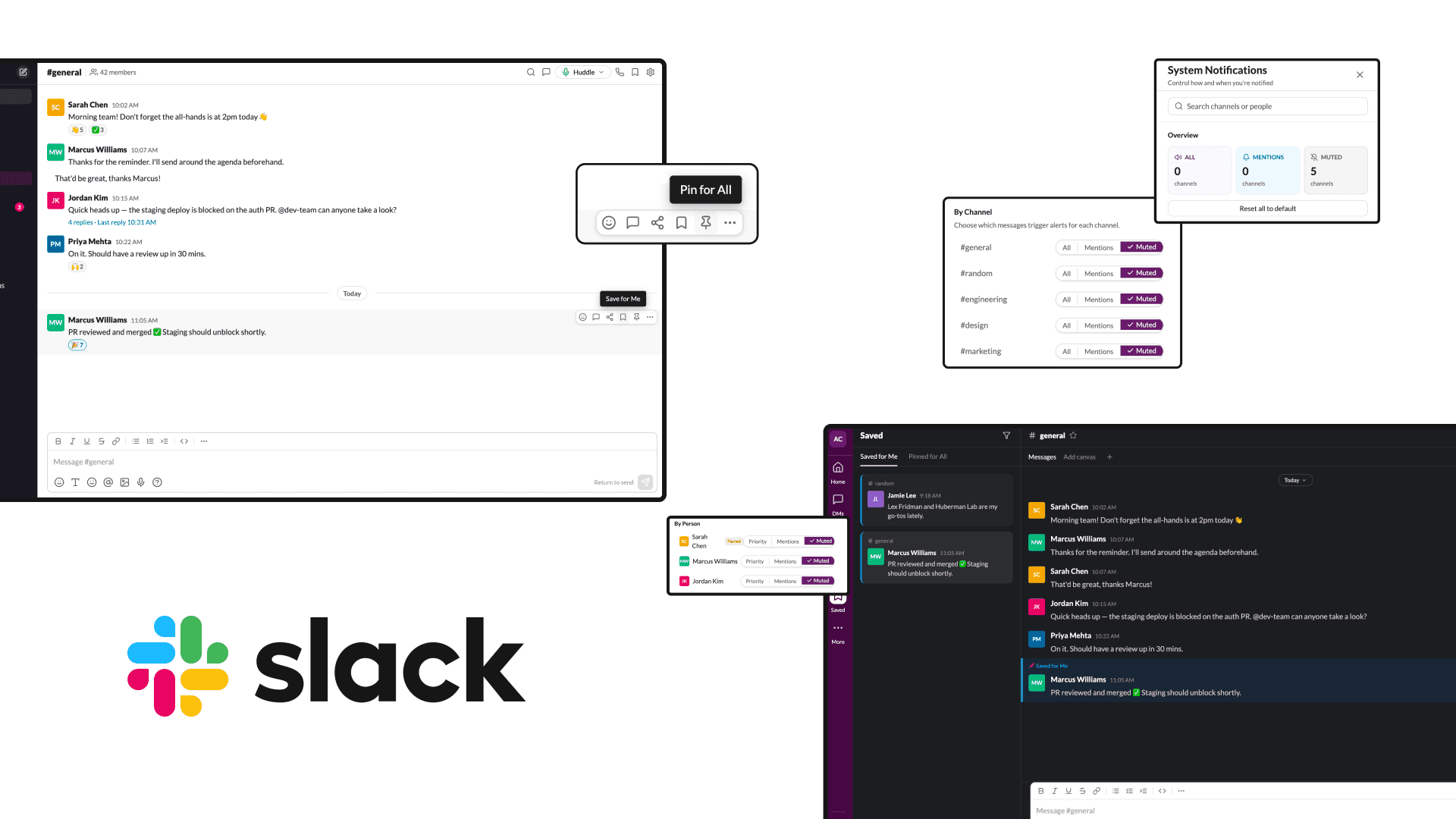
Save For Me vs Pin For Everyone
Instead of forcing users to interpret platform terminology like Saved, Pinned, and Later, actions were rewritten to clearly communicate ownership and destination. The distinction users already understood conceptually was finally reflected in the interface.
Before
Before screenshot
After
After screenshot
37.5%
100%
Task success rate on message retrieval after redesign
Redesign 02
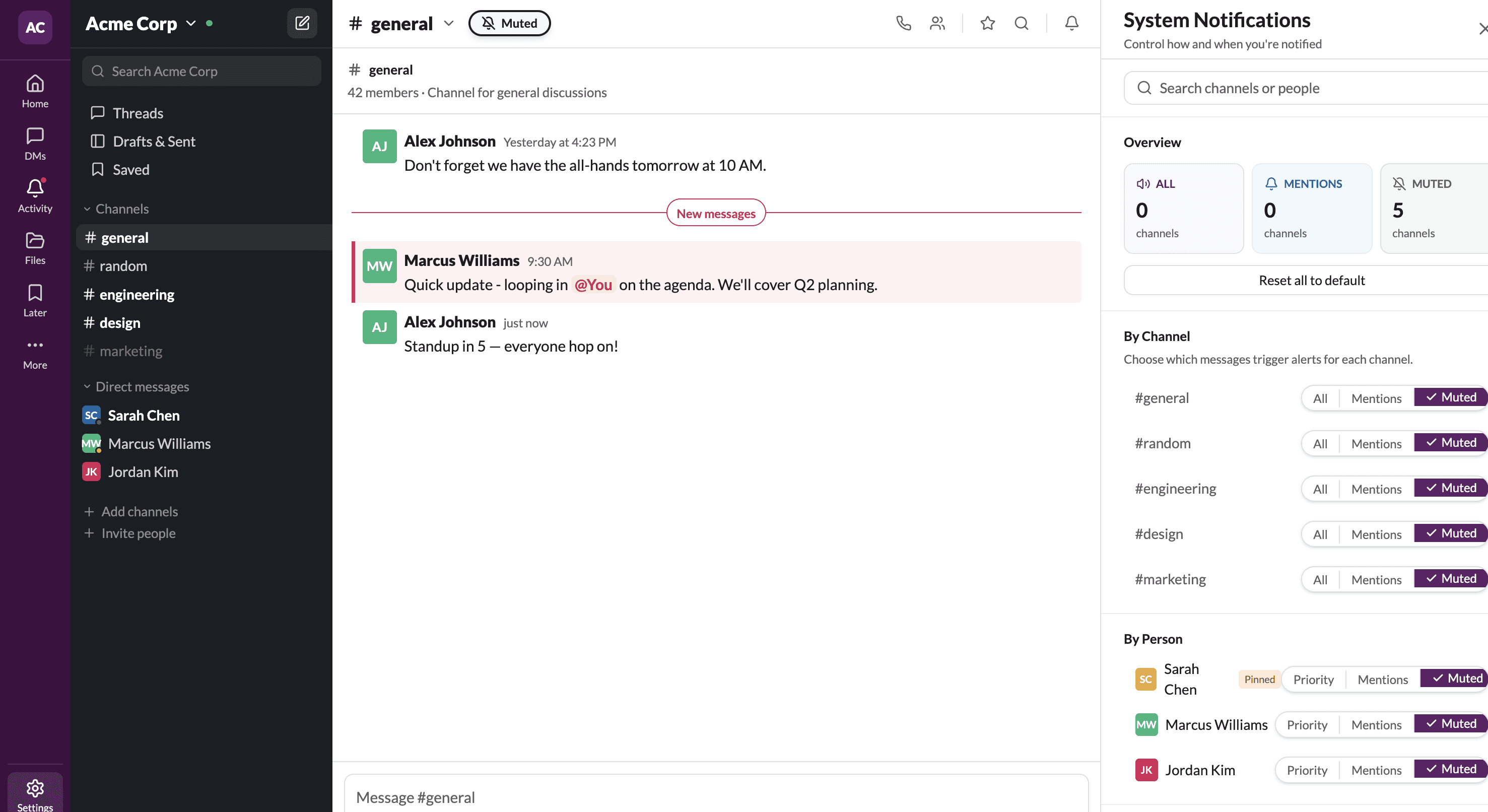
Unified Notification Center
A persistent notification status indicator and centralized control panel replaced three separate settings locations. Users could now see what was active, understand why notifications were appearing, and change settings from one place. The fix was not about adding features. It was about making what already existed visible.
Before
Before screenshot
After
After screenshot
25%
100%
Task success rate on notification management after redesign
Business Value
Why this matters beyond the test session.
Slack is used hundreds of times per day across every team in an organization. When core features like saved messages and notification settings are too confusing to use correctly, the cost is not one failed task in a lab. It is every employee, every day, slightly less productive than they should be. Small usability fixes compound into real organizational gains.
Productivity up
When users can find information and trust system feedback, they spend less time searching and more time doing actual work.
Support load down
Confused users become support tickets. Clear interfaces reduce the volume of questions that reach IT and operations teams.
Feature adoption up
Features users cannot find are features that do not exist for them. Better visibility drives genuine usage across the organization.
Onboarding faster
New team members get productive faster when the tool communicates clearly. Every week of confusion has a measurable cost.
Good communication tools should not make users guess. Visibility creates confidence, and confidence creates efficiency. These two redesigns prove that small, targeted changes to information architecture and language can move task success from near-zero to 100%.
The Outcome
Clear systems create confident users.
Before the redesigns, users regularly believed they completed tasks when they had not. The interface gave them no signal that anything was wrong, so they moved on with the wrong answer.
After: users could locate saved information, understand notification settings, and complete tasks without confusion or guesswork. Both severity-4 issues went from near-complete failure to 100% task success.
37.5%
100%
Message retrieval success
25%
100%
Notification management success